William Chester Minor’s contributions to the Oxford English Dictionary
The Surgeon of CrowthorneWilliam Chester Minor’s contributions to the Oxford English Dictionary were distinguished not simply by their number but by the method behind them: instead of sending quotations as he encountered them, Minor read widely, built detailed indexes of his books, and supplied evidence when the editors asked for particular words. Working from his cell at Broadmoor Asylum for the Criminally Insane, he turned prolonged confinement into sustained scholarly labour, and his first especially fruitful response helped establish a connection with James Murray that lasted for decades.
Recruitment and uncertain beginnings
Murray’s appeal for volunteers followed the formal agreement to edit the New English Dictionary on Historical Principles. In 1879, he circulated an eight-page appeal to English-speaking readers, asking them to read books that remained unexamined and extract useful evidence. The appeal named periods and authors where help was needed, with particular attention to the largely unexplored eighteenth-century literature. Copies reached readers through newspapers and magazines, bookshops, libraries, and other public outlets.
One copy may have reached Minor among books brought to him by Eliza Merrett, who had offered to collect and deliver his orders. The book parcels were a temporary arrangement, and the route by which Minor encountered the appeal cannot be established with certainty. The evidence supports a probable beginning, not a documented moment of discovery.
Minor formally offered his services as a reader, but the date is unresolved. Murray later remembered hearing from him very soon after the Dictionary work began, while no correspondence between Minor and the project has been traced before 1885. An article encouraging American readers to contribute appeared in the Athenaeum in September 1879; because Minor subscribed to the magazine, he may have read it. Taken together with Murray’s recollection and records of Minor’s later contributions, this makes 1880 or 1881 a probable starting period rather than a confirmed date.
Murray initially knew little about his correspondent. Minor’s letters came from Broadmoor, Crowthorne, Berkshire, but Murray did not at first connect the address with an asylum. He supposed that the writer was a practising or retired medical man with literary interests and leisure. In fact, Minor had been an inmate at Broadmoor for eight years by the time the appeal reached him. He was a well-read, curious Yale graduate, and the prospect of useful intellectual work offered occupation during an otherwise open-ended confinement.
A private system of reading and indexing
Murray replied courteously, inviting Minor to begin with books he already owned or request volumes from the Dictionary office. The work was initially general rather than directed at individual words: Minor was to read, make word-lists, and record quotations systematically. Murray also sent printed guidance confirming his welcome as a volunteer. At that stage, the editor had received about eight hundred responses and had little reason to know who Minor was beyond what his letters suggested.
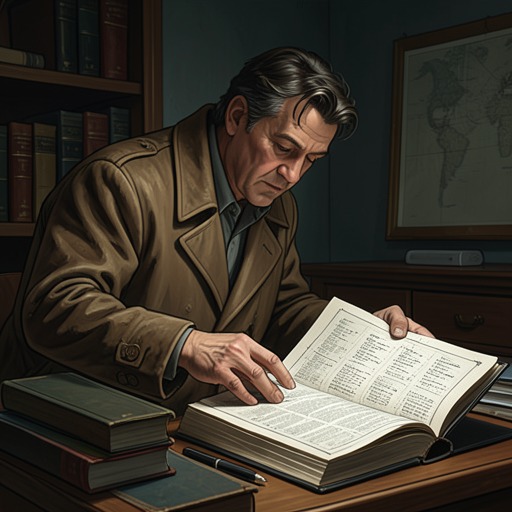
Minor’s procedure differed from that of readers who sent in interesting quotations as they came across them. He first made a comprehensive word-list for each book, rather than immediately forwarding individual slips. The account uses a volume Minor owned, a 1693 London translation of Jacques Du Bosc’s Compleat Woman, as an illustrative example; it does not establish that this was the first book he read for the Dictionary. For such work he prepared a small booklet by folding a single quire of paper, then recorded each notable word in tiny handwriting, placing it in its proper position in the list.
The precision extended beyond spelling. Minor noted where a word occurred in the source, including its page, and recorded recurring forms and instances. In Compleat Woman, for example, he registered feel on sixteen pages, although some appearances were forms such as feeling rather than the exact word. His surviving quires show a consistent system built to make material retrievable, not merely to preserve a miscellany of interesting language.
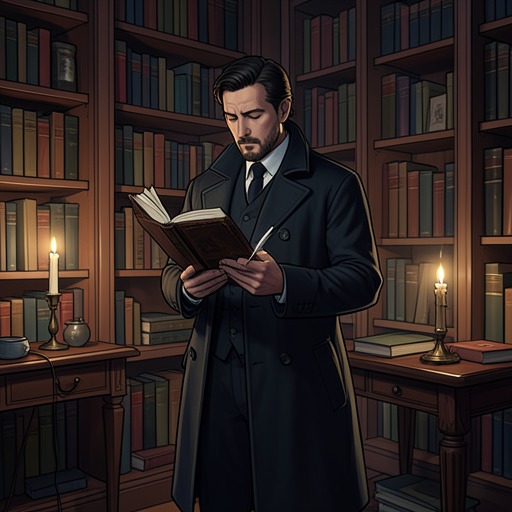
A book could take months to process. Minor continued from one volume to another, accumulating master-lists and indexes among the books in his cell. His collection included works on travel and history, among them Thomas Herbert’s account of travels in Africa and Asia and a 1582 translation of Lopes de Castanheda’s history of the East Indies. The method gave his reading a cumulative purpose: each completed book enlarged an organized store of evidence that could later be searched for the Dictionary’s needs.
Supplying words on request
By the autumn of 1884, Minor had accumulated enough indexed words and accessible quotations to ask the editors which words they needed. That step made his system useful in a way that ordinary batches of unsolicited slips were not. He could consult the progress of the Dictionary, identify a requested word in his own indexes, return to the relevant page in a source book, and transcribe a suitable sentence onto a quotation slip. He sent the evidence only after locating the specific request in his organized material.
For the editors, the result was a dependable reserve of indexed words and citations at Crowthorne. Instead of relying only on searches through their shelves and accumulated slips, staff could write to Minor about a troublesome word and ask him to check his lists. His work thus depended on a chain of communication and handling: editorial requests identified a need, Minor’s indexes located possible evidence, source books supplied the full context, and the resulting slips could be incorporated into the Dictionary’s workflow.
The first test of this arrangement concerned art, a word whose meanings had caused difficulty in the Oxford office. The editors asked whether Minor had evidence for earlier quotations or additional senses. Eighteen readers replied to the request; most offered only a sentence or two. Minor sent twenty-seven quotations, demonstrating both the depth of his reading and the value of his accumulated indexes. Many came from Sir Joshua Reynolds’s Discourses, published in 1769. One became the earliest known quotation from Minor to appear in the finished Dictionary, under the sense relating to the arts.
A lasting scholarly relationship
The response on art revealed Minor to Murray’s staff as a meticulous and unusually prolific contributor. His work continued for the next two decades, at times exceeding a hundred new slips in a week and reaching twenty in a day. He wrote formally to Murray, generally keeping his correspondence within the bounds of the work, and continued to answer editorial needs with evidence drawn from his books and indexes.
The contribution also became the beginning of a relationship that exceeded the exchange of slips. Murray and Minor did not meet until January 1891, seven years after the request on art. A later, widely repeated account of their first encounter, published by Hayden Church in 1915, heightened the drama by presenting the meeting as a sudden discovery that Murray’s correspondent was an inmate in a criminal asylum. The account was a journalistic fiction, not a reliable record of the meeting. Murray’s 1902 letter to Francis Brown, together with the surviving chronology, supports a more gradual history: he had corresponded with Minor for years before visiting him, and the two men then met and saw one another regularly for almost twenty years.
The Dictionary’s debt to Minor rested on sustained work rather than a single dramatic revelation. His system made a private library function as a searchable resource for the editors, and his carefully indexed reading let him respond when the project needed evidence for particular words. The first known quotation from him to enter the finished work marked both a practical success for the Dictionary and the start of a durable bond between two scholars whose circumstances were markedly different but whose attention to words was shared.